Split the bill calculator for when everyone ordered something different
Four friends, one bill for $165.12. One had the steak and dessert, one skipped the wine. Dividing by four is quick, and about $6 off for two of them.
4 min read

Split the bill calculator, item by item
Enter who had what, the plates and bottles you shared, tax and tip: each person's share comes out to the cent, with what everyone owes whoever paid. No account, no email address, and nothing is saved.
The form is filled in with the example from this article: an 8% sales tax and a 20% tip on the items. Replace the values, or clear everything to start from scratch.
The result of the example
- Items subtotal
- $129.00
- Sales tax, 8% of the subtotal
- $10.32
- Tip, 20% of the subtotal
- $25.80
- Bill total
- $165.12
Each item
- Burger, $18.00: Alex
- Pasta, $22.00: Sam
- Salad, $15.00: Nora
- Steak, $26.00: Tom
- Nachos, $12.00: shared by 4: Alex $3.00 · Sam $3.00 · Nora $3.00 · Tom $3.00
- Bottle of wine, $28.00 *: shared by 3: Alex $9.34 · Sam $9.33 · Nora $9.33
- Dessert, $8.00: Tom
* These items did not divide to the cent: the leftover cents go to the shares with the largest remainder, then to the first person on the list. The shares always add up to the price. Tax, tip and service are split in proportion to each person's items, the same way to the cent.
Each person's share
| Person | Items | Sales tax (8%) | Tip (20%) | Share | Equal split |
|---|---|---|---|---|---|
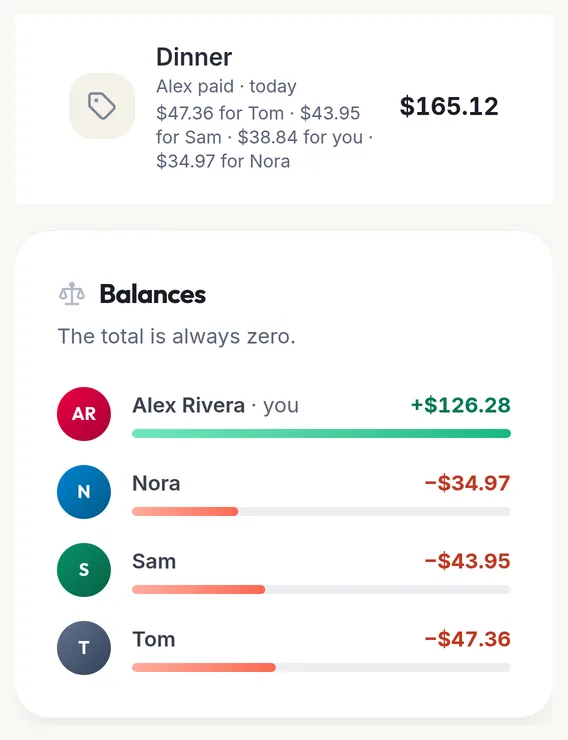
| Alex | $30.34 | $2.43 | $6.07 | $38.84 | $41.28 |
| Sam | $34.33 | $2.75 | $6.87 | $43.95 | $41.28 |
| Nora | $27.33 | $2.18 | $5.46 | $34.97 | $41.28 |
| Tom | $37.00 | $2.96 | $7.40 | $47.36 | $41.28 |
Sum of the shares: $165.12, exactly the bill total ($165.12).
Divided equally, everyone would pay $41.28: the last column, for comparison.
Who pays back whom
Paid: Alex $165.12
- Tom pays $47.36 back to Alex
- Sam pays $43.95 back to Alex
- Nora pays $34.97 back to Alex
To split a restaurant bill when people ordered different things, give each dish to whoever had it, divide shared plates and bottles between the people who shared them, then add tax and tip in proportion to each person's subtotal. Enter the items in the calculator above: it gives each share to the cent and how much each person owes whoever paid.
It needs no account, and a calculation stores nothing. If the meal was simple and everyone ordered about the same, an equal split is fine; the calculator is for the evenings where it is not.
How the calculation works
- Each dish goes to whoever ordered it. A main course, a dessert, a drink that only one person had.
- Shared items are divided between the people who shared them. A starter for the table is divided by everyone; a bottle of wine only by those who drank it.
- Each person's subtotal is the sum of their dishes and their shares.
- Tax and tip are added in proportion to the subtotal. Someone who ordered $40 of food pays twice the tip of someone who ordered $20. That keeps each person paying the same percentage of their own order.
Many people tip on the amount before tax. The calculator applies each percentage to the subtotal of the items; if your tip is already a fixed amount, or a service charge is already printed on the bill, enter it as a line of its own instead of adding a second one.
The tax rate and tip in the example are hypotheses: sales tax depends on where you eat, and the tip is your choice. Use the rate printed on your bill.
The cases that start arguments
Someone did not drink. Leave them out of the drinks. This is the most common reason an equal split feels wrong, and the easiest to fix.
Someone's birthday. If the group pays for the person celebrating, add their dishes to the shared items of everyone else. Their share becomes zero and the others split it equally.
Someone left early. They pay what they had and their part of whatever was shared while they were there. A dessert ordered after they left is not theirs.
Several cards on one bill. If two people paid part of the bill each, enter both payments: the calculator works out each person's balance against the total, and who pays back whom.
Rounding. Shares are rounded to the cent, and the leftover cents go to the largest remainders, so the shares always add up to the bill. Rounding everyone up to the dollar is friendlier, but then someone ends up paying the difference without noticing.
When the dinner is part of a trip
On a trip, the restaurant bill is one expense among many: the rental, the groceries, the fuel. Settling each meal on the spot multiplies small transfers. It is simpler to note each expense with who it concerns and settle once at the end: who owes who explains how the balances are worked out, and the group trip budget guide covers the rest of the trip.
Keeping track in Kotisso
Kotisso is a free app for sharing expenses with the same people over time: a dinner goes in as one expense, split between the people who were there, next to everything else the group shares. It shows each person's balance to the cent and who pays back whom; the transfers themselves happen outside the app. The button under the calculator keeps this split in a group when you sign up.
Frequently asked questions
How do you split a bill when everyone ordered something different? Give each dish to whoever ordered it, divide shared items between the people who shared them, then add tax and tip in proportion to each subtotal. The calculator above does the arithmetic to the cent.
Should the tip be split equally or by what each person ordered? By what each person ordered keeps everyone at the same percentage. In the example, Tom's share of the tip is $7.40 and Nora's $5.46, because Tom ordered more.
How do you split a bottle of wine when not everyone drank? Divide it only between those who drank it. In the example, the $28 bottle comes to $9.34 for one person and $9.33 for the other two.
Is an equal split ever better? Yes, when everyone ordered about the same, or when the group simply prefers not to count. The calculator shows both, so you can see how far apart they are before deciding.